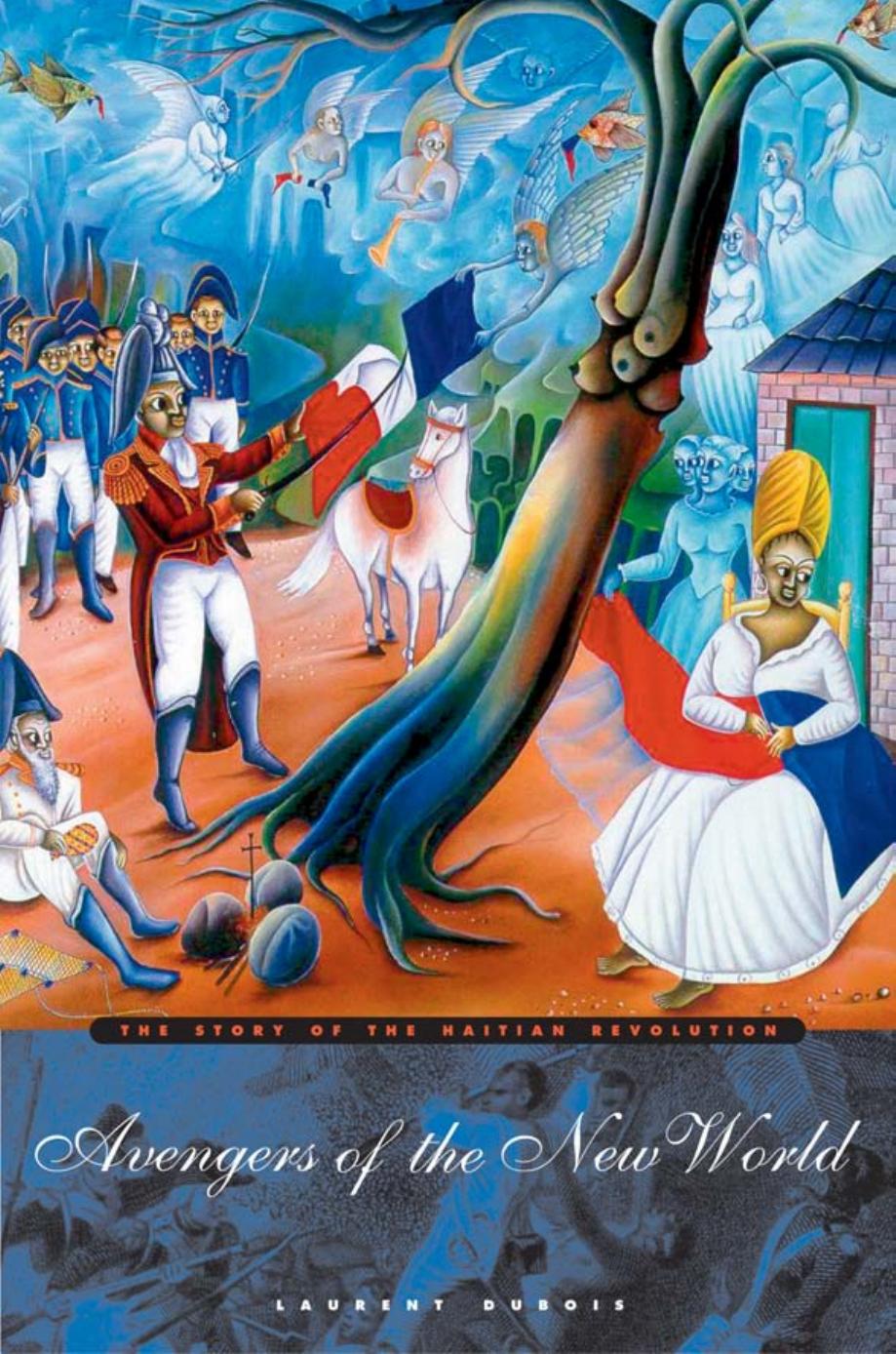
Avengers of the New World: The Story of the Haitian Revolution by Laurent Dubois
Author:Laurent Dubois [Dubois, Laurent]
Language: eng
Format: epub, pdf
Published: 0101-01-01T00:00:00+00:00
c h a p t e r n i n e
Power
Do you believe, citizens and colleagues,” Jean-Baptiste
Belley asked the National Convention in early 1795, “that nature
is unjust, that she has, as the planters assert, made some men
to be the slaves of others?” Belley had been serving as one of Saint-
Domingue’s representatives since the year before, when he and his col-
leagues had precipitated the vote abolishing slavery throughout the French
empire. Already, however, some of the men who served alongside him
were clamoring against the liberty decree. A representative from the In-
dian Ocean colony of Ile de France, the planter Marie-Benoît-Louis
Gouly, delivered a speech to the Convention portraying the ex-slaves of
Saint-Domingue in starkly racist terms.1
It was absurd, Gouly insisted, to grant freedom and citizenship to peo-
ple whose souls were accessible “only through the organ of hearing,” ani-
mated only by the “loud sounds of a drum or a voice expressed with force,”
whose eyes had no “vivacity,” and whose very “figure” presented “the im-
age of stupidity.” “He acts and does not reflect; he seldom speaks and often
sings; never does a profound sentiment of pain or pleasure cause tears to
stream from his eyes.” “He suffers and never complains,” Gouly continued.
“He has no desires, loves repose, and absolutely hates work; his pleasure is
to do nothing, and he finds all his happiness in sleeping.” Such individuals
had, in short, none of the capacities required for citizenship. Having made
this argument, Gouly reiterated the arguments made before emancipation
by thinkers like Moreau de St. Méry, asserting that the colonies must be
governed by particular laws different from those applied in the metropole.2
Gouly’s racism was nothing unique; it was part of a proslavery tradition
that would haunt the Atlantic world for a long time to come. What was
unique was the presence, at the heart of France’s government, of a former
slave who could counter these assertions through his words and his very
presence. “I was born in Africa,” Belley announced proudly in response to
Gouly’s “bizarre portrait” of the ex-slaves. Although the blacks had been
brutalized by their masters, he explained, they had remained men. Their
insensitivity was not an essential attribute, but the result of the degradation they had experienced at the hands of “cruel masters” like Gouly, “a tiger
who for twenty-five years devoted himself to torturing Africans” while
making his living “on the sweat and blood” of slaves.3
Belley explained how, brought “as a child to a land of tyranny,” he had
gained his liberty thirty years before through “hard work and sweat.” Since
that time, he announced, “I have always loved my country.” The same was
true of the blacks recently made “free and French” in Saint-Domingue,
who “bravely” defended “the rights of the Republic.” The white slave mas-
ters—“born dominators”—had, in contrast, busily handed over as much of
the colony as they could to the British. The ex-slaves were clearly quite ca-
pable of serving France. It was the disloyal planters who were undeserving
of citizenship. Gouly wished to see only “chains, slaves, and tyrants” in the Caribbean, and his “negrocidal” ideas were a threat to France and to the
Rights of Man.4
“Let it no longer be
Download
Avengers of the New World: The Story of the Haitian Revolution by Laurent Dubois.pdf
This site does not store any files on its server. We only index and link to content provided by other sites. Please contact the content providers to delete copyright contents if any and email us, we'll remove relevant links or contents immediately.
| Africa | Americas |
| Arctic & Antarctica | Asia |
| Australia & Oceania | Europe |
| Middle East | Russia |
| United States | World |
| Ancient Civilizations | Military |
| Historical Study & Educational Resources |
Cat's cradle by Kurt Vonnegut(15466)
Pimp by Iceberg Slim(14709)
4 3 2 1: A Novel by Paul Auster(12539)
Underground: A Human History of the Worlds Beneath Our Feet by Will Hunt(12170)
The Radium Girls by Kate Moore(12110)
Wiseguy by Nicholas Pileggi(5870)
The Fire Next Time by James Baldwin(5536)
Perfect Rhythm by Jae(5492)
American History Stories, Volume III (Yesterday's Classics) by Pratt Mara L(5348)
Paper Towns by Green John(5262)
Pale Blue Dot by Carl Sagan(5096)
A Higher Loyalty: Truth, Lies, and Leadership by James Comey(5030)
The Doomsday Machine by Daniel Ellsberg(4574)
The Mayflower and the Pilgrims' New World by Nathaniel Philbrick(4565)
Killers of the Flower Moon: The Osage Murders and the Birth of the FBI by David Grann(4496)
The Sympathizer by Viet Thanh Nguyen(4460)
Too Much and Not the Mood by Durga Chew-Bose(4404)
The Borden Murders by Sarah Miller(4402)
Sticky Fingers by Joe Hagan(4268)
